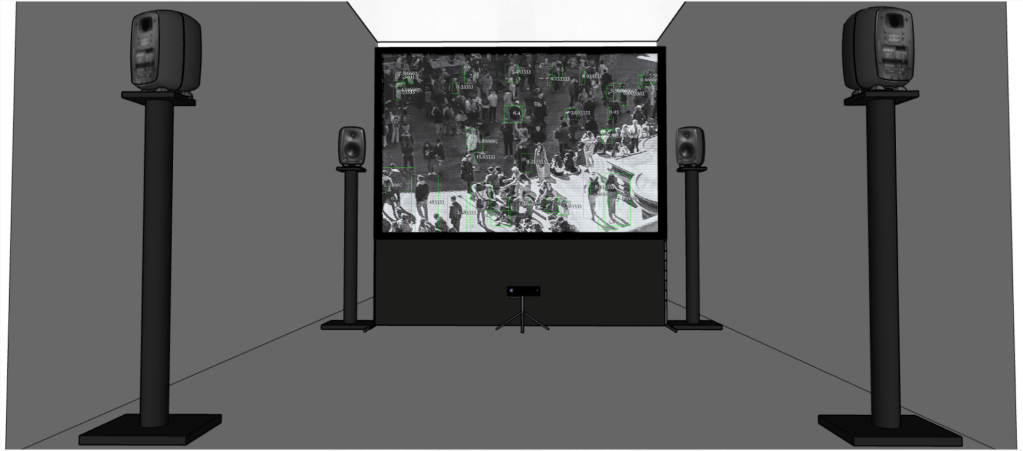
Scheletri
Scheletri (2025) is an interactive audiovisual installation that explores the relationship between body, identity, and virtuality. The title suggests a reflection on the reduction of the individual to their most elementary essence: a universal structure devoid of identifying details, which becomes a symbol of the growing depersonalization in contemporary technological society. The concept of the skeleton also refers to how the body is represented by the interactive system, based on skeleton tracking—namely, the coordinates of the viewer’s movement. The work questions the fragility of identity in the age of digitalization, in which personal information is extracted, archived, and manipulated until it loses its connection with the real individual.
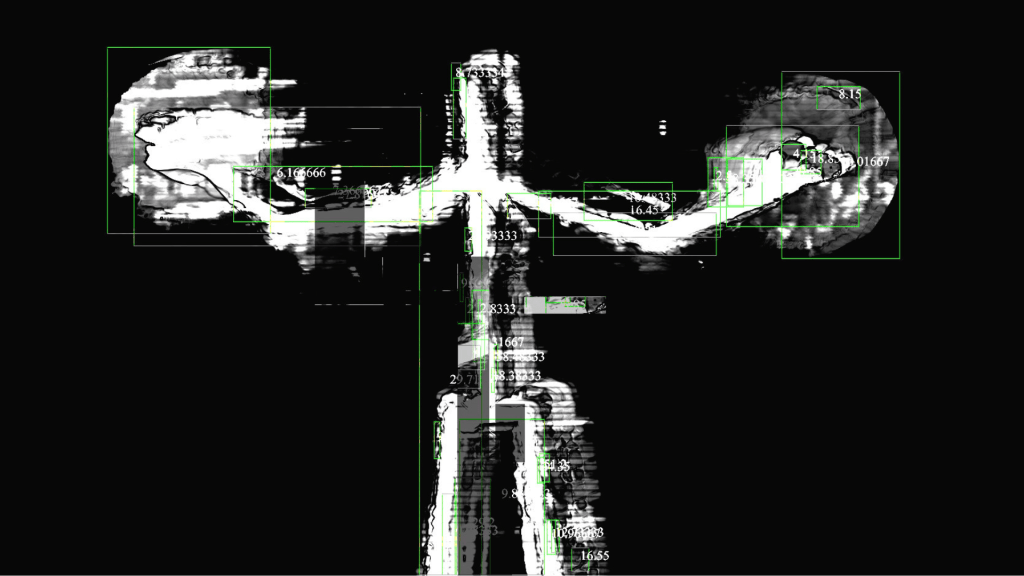
VIDEO MATERIALS
The videos were created from footage captured through public webcams, freely accessible online and located in different places across Italy. The use of public webcams places the viewer in an ambivalent position: on the one hand, they observe fragments of everyday life that would otherwise go unnoticed; on the other, they are forced to confront the fact that these images exist precisely because they are recorded by a system of permanent surveillance.
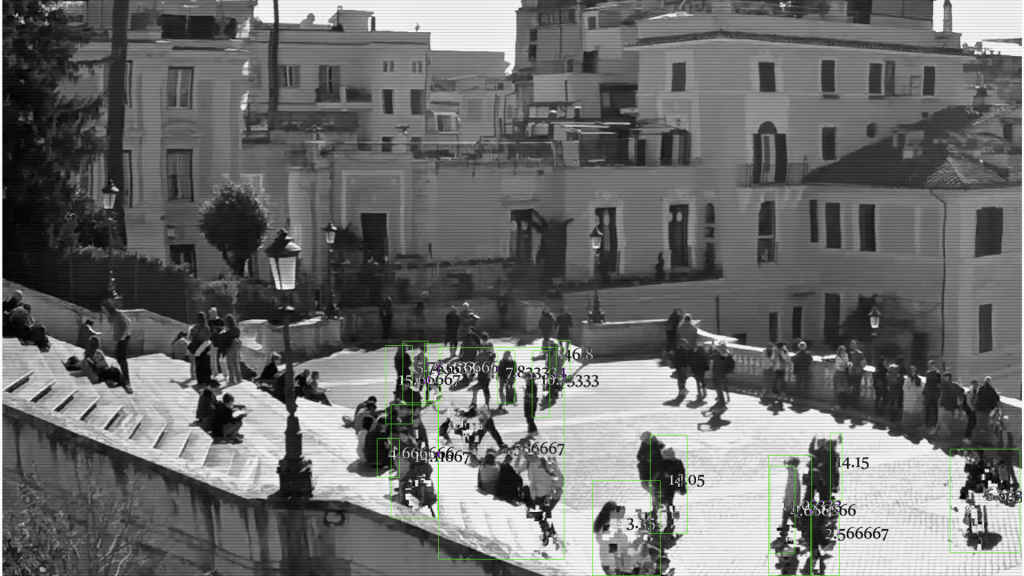
AUDIO MATERIALS
The sonic dimension of Scheletri emphasizes the relationship between body and audiovisual space: every gesture becomes a sound event that exaggerates and amplifies the viewer’s presence. Timbrically, the work blends realistic and artificial sounds, creating an estranging effect in which the viewer recognizes their own movement yet senses a gap between action and sonic representation. Field recordings anchor the piece to the real acoustic identity of the filmed locations, while synthesized and sample-processed sounds expand this layer. Electromagnetic microphone recordings—capturing normally inaudible electronic emissions such as interference, hums, and impulses—further intensify the contrast between natural and technological soundscapes.
INTERACTIVE SYSTEM
Interaction in Scheletri, based on Kinect v2, unfolds across three levels. First, chest coordinates detect the viewer’s presence inside the speaker-defined area: entry activates the installation, while absence triggers a “stop” state and a random reorganization of materials for the next visitor. Second, sonic interaction operates through real-time audio processing mapped to movement, the triggering of samples that mark the shift from physical to digital, and five-speaker spatialization. Third, visual interaction alternates between live skeleton tracking—projecting a digital silhouette and movement coordinates—and the random playback of one of nine interactive videos.
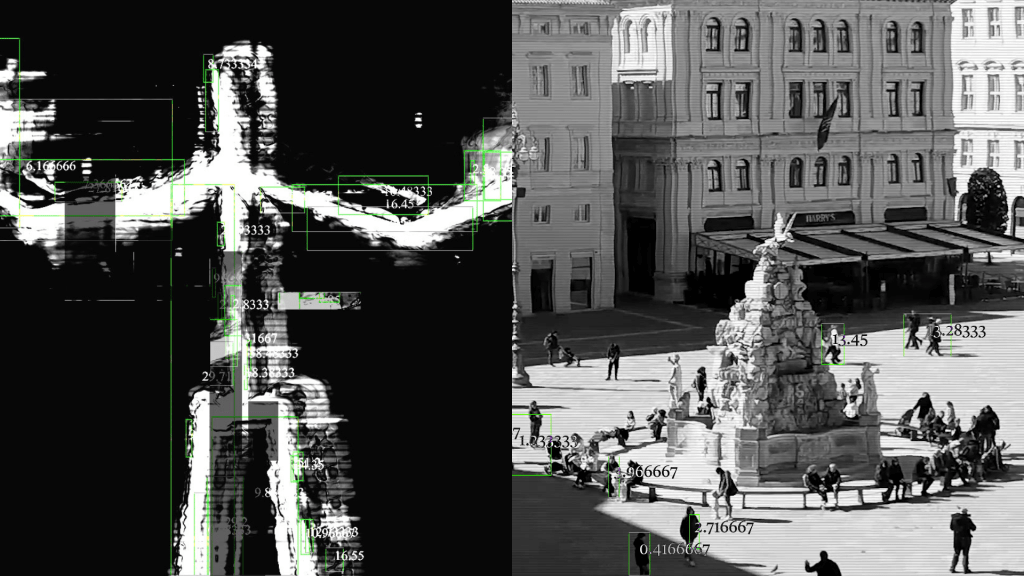
EXPERIENCE / VIEWING MODE
The installation is designed to be experienced by one viewer at a time. This choice stems from the conceptual nature of the work, which explores the relationship between the individual and their digital representation. A single-viewer experience enables a more direct dialogue between the viewer and the installation.